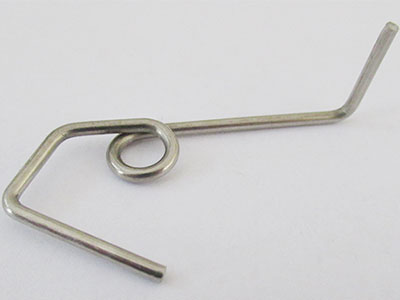
The special-shaped spring is the most common mechanical part. It is an essential component in most equipment and products. It is a widely used and practical part. When the spring is placed horizontally, the guide pin and the spring will wear and crack. When the flatness of the installation surface is poor or the parallelism of the mating surface is bad, the spring will twist, and local high-pressure cracking will occur. In cases of poor parallelism, the spring will twist and crack beyond 300,000 cycles of use. Please improve the parallelism of the installation surface within 300,000 cycles of use. The application without pre-load will cause the spring to vibrate up and down due to the gap, resulting in the spring twisting. If there is pre-load, the spring will be more stable. When the application pressure exceeds a larger compression amount, it will cause damage. For applications close to the tight fit length, the spring wire part will gradually become tight. Therefore, due to the increase in the hardness of the spring's material, the load curve will increase, and subsequently, high stress will cause the spring to crack. Do not use beyond 300,000 cycles. When the outer diameter of the spring is too small compared to the blind hole or the gap between the blind hole and the spring is too small, the external side of the spring will expand due to the compression of the spring and will rub against the blind hole, causing a force concentration crack. The better blind hole diameter is the outer diameter of the spring plus 1.5mm.
Special-shaped spring
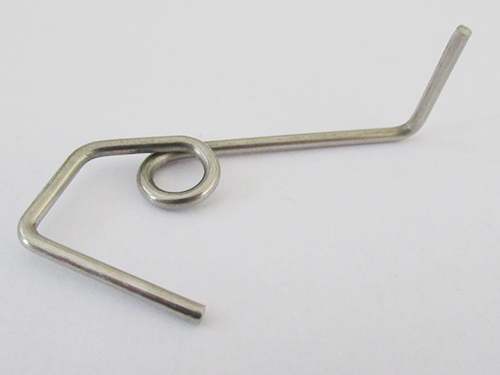
An irregular-shaped spring is a machine part that utilizes elasticity to function. The parts made of elastic materials will deform under the influence of external forces, and will return to their original state after the external force is removed. There are various types of springs, classified by their shapes, including spiral springs, coiled springs, leaf springs, and irregular-shaped springs. They are generally made of spring steel. So, what are the requirements for the materials used to manufacture springs?
High intensity
To enhance the resistance to fatigue damage and loosening of special-shaped springs, the spring material should have high yield strength and elastic limit, and a high yield-to-strength ratio. Under normal conditions, the elastic limit of the material is directly proportional to its yield strength. Therefore, spring designers and constructors always expect the material to have high yield strength.
2. Excellent plasticity and toughness
During the construction process of special-shaped springs, the materials need to withstand different levels of processing deformation. Therefore, the materials are required to have sufficient plasticity. For example, for complex-shaped tension and rotation springs with hooks and arms, when the curvature radius is very small, during the processing of winding or stamping into a curved shape, the spring materials must not have defects such as cracks or damage. At the same time, when the spring is subjected to impact loads or variable loads, the materials should have excellent toughness, which will greatly benefit the improvement of the application life of the spring.
3. Exquisite physical appearance and sluggish functions
When a spring is subjected to external stress, its outer surface bears greater stress. And fatigue failure often originates from the outer surface of the steel wire. For springs used in critical applications such as valve springs, gate springs, and suspension springs, they are required to have a cycle life of several million, tens of millions, or even longer. This places very high demands on the fatigue performance of the material. There are many factors that affect the fatigue performance of the material, such as the chemical properties of the material, hardness, purity of the steel, surface quality, and microstructure. Particularly important is the surface quality of the material.
4. Harsh dimensions
Many special-shaped springs have high requirements for load accuracy. For example, the load error of valve springs should not exceed 5% - 6% of the specified load. Taking the compression and tension springs made of round steel wires as an example, if the diameter error of the steel wire is 1%, the load will have an error of around 4%. Thus, strict dimensional accuracy is also very crucial for ensuring the quality of the springs.
5. Good Proportionality
The requirement for the uniformity of materials refers to the requirement for the chemical properties, mechanical performance, dimensional errors, etc. of the materials to be uniform and consistent. If the various performance parameters of the materials differ, it will cause significant problems for the production of springs, resulting in differences and distinctions in parameters such as size, hardness, load, etc. The severe inhomogeneity of special-shaped springs may even lead to waste.
Mr. Zhang:+86 135-0969-2053

Mobile website
WeChat Official Account
Copyright © 2026 Dongguan Jiqixing Industrial Co., Ltd. All rights reserved
The web page materials and related resources on this site are all sourced from the Internet. If there is any infringement, please notify us immediately. We will delete them within 24 hours.